Every facility that generates regulated waste eventually runs into the same operational question: How does that waste get from your site to a permitted disposal facility? Is the method safe and compliant? There are only two ways to make that happen: scheduled hazardous waste pickup or dropoff. Neither one is automatically the right call for every generator, waste stream, or budget.
The answer usually comes down to five factors:
- How much waste you generate
- What type of waste it is
- How much you can safely store onsite
- How far you are from a permitted TSDF
- Whether you’re equipped and authorized to transport it yourself
For many generators, scheduling hazardous waste pickup solves all five problems at once. For others, hauling waste directly to a facility makes more sense. So how do you tell which option best fits your operation?
The Two Ways Waste Reaches a Disposal Facility
However your waste travels, it has to end up in the same place: a fully permitted treatment, storage, and disposal facility, or TSDF.
Pickup means a permitted hauler (such as Miller Environmental Group) collects containerized or bulk waste from your site and transports it to the disposal facility on your behalf. Drop-off means your team packages, labels, and transports approved waste directly to the TSDF facility.
Both routes require the same compliance foundation: an approved waste profile, proper labeling and packaging, and a manifest that travels with the waste from generation to final disposal. The person responsible for transportation carries implications for cost, liability, and day-to-day logistics.
Option 1: Scheduled Waste Pickup
With scheduled hazardous waste pickup, containers are staged onsite and a permitted hauler collects them on a set schedule or on an on-call basis. The hauler handles DOT-compliant transport and the manifest travels with the load from your dock all the way to the disposal facility.
For generators with recurring waste streams or multiple locations, many providers also offer milk-run or route-based pickups, combining stops at several sites into a single, efficient trip. That keeps costs down without sacrificing compliance.
Scheduled pickup tends to be the better fit when:
- Waste volume is recurring rather than a one-time event
- The waste stream includes bulk liquids or sludges that are difficult to move safely without specialized equipment
- Onsite storage space is limited and containers need to move out quickly
- You operate multiple sites and want consolidated, predictable logistics
- Your facility doesn’t have DOT-authorized drivers, vehicles, or hazardous waste transportation permits
We want to emphasize that last point: Transporting hazardous waste isn’t as simple as loading a truck. It requires DOT hazmat certification, proper vehicle placarding, and ongoing compliance with hazardous waste transportation regulations that most generators aren’t set up to handle in-house. Hazardous waste pickup shifts that regulatory burden onto a hauler who already meets those requirements.
Option 2: Hazardous Waste Drop Off at a TSDF Facility
Some generators are equipped to bring their own waste to a permitted facility, either because they have DOT-authorized transport in-house or because their volume doesn’t justify a scheduled route.
Choosing hazardous waste drop off starts the same way pickup does: with an approved waste profile, proper containers and labeling that match the waste’s classification, and a manifest prepared in advance. Once that’s in place, the facility coordinates a scheduled receipt so your load can be processed without delay.
This option tends to work best when:
- Waste volume is small or one-time, not recurring
- Your facility is located near a permitted TSDF
- You already have the vehicles, drivers, and DOT authority needed to transport hazardous materials legally
- You want more direct control over transport timing
Generators considering drop off should confirm the receiving facility’s accepted waste streams, hours, and profile requirements before loading a truck. Every TSDF has its own acceptance criteria, and confirming those details in advance saves you from a wasted trip.
How to Choose Between Pickup and Drop-Off
The right choice comes down to: volume and frequency; waste stream and hazard class; onsite storage limits; proximity to a permitted TSDF facility; in-house transport and DOT compliance; and total cost.
“The safest disposal decision is rarely the cheapest one on paper. It’s the one that matches your waste stream, storage capacity, and compliance capability.”
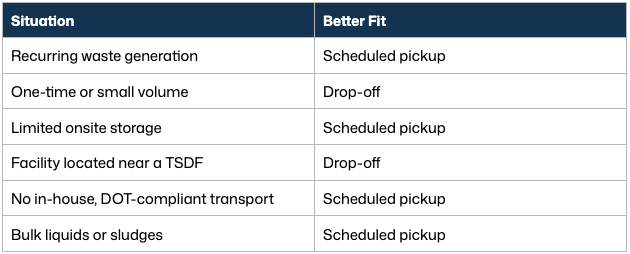
Either Way, the Waste Profile Comes First
Whether you choose hazardous waste pickup or hazardous waste drop off, nothing moves until your waste has an approved profile. A waste profile documents the waste’s composition, hazard classification, and handling requirements, and it’s what allows a permitted TSDF to legally accept it in the first place.
Profiling typically involves waste characterization, analytical testing (when required), and documentation that satisfies EPA, state, and DOT regulations. Skipping or rushing this step is the most common reason a scheduled pickup gets delayed or a drop-off gets turned away at the gate.
If you haven’t profiled a waste stream yet, start with a waste profile form before scheduling transport in either direction.
Miller Environmental Group’s Disposal Network & Pickup Services
Miller Environmental Group has been guided by safety and compliance since 1971, and it shows in how we support both sides of this decision. Miller operates seven fully permitted TSDFs, backed by an integrated, DOT-compliant transportation network built to move regulated waste safely and efficiently, with national reach and local coverage.
That combination means Miller can support your operation whichever route makes sense: scheduled hazardous waste pickup for recurring volumes and multi-site operations, or coordinated hazardous waste drop off for generators who prefer to handle their own transport. Either way, our team helps you profile the waste correctly the first time, so there are no surprises at the gate.
Ready to move your waste the right way? Request a quote to get started. You can also explore our disposal facility locations and Waste Transportation & Disposal pages to see how Miller’s network can support your site.
