Is a hazardous waste manifest important? The answer is a resounding “yes.” It’s the document an inspector asks for first. It’s the document your insurer wants on file. It also stands between you and an open-ended liability question. If you’ve read our posts on hazardous waste pickup vs. drop-off and hazardous waste disposal methods, you know how waste leaves your site and what happens once it reaches a permitted facility. A hazardous waste manifest is the paperwork that proves both of the aforementioned steps took place.
What a Hazardous Waste Manifest Is
But what is it? A hazardous waste manifest is the legal document that tracks a shipment of hazardous waste from the moment it leaves your site to the moment it’s treated, recycled, or disposed of at a permitted disposal facility. It’s proof of custody at every step that you can use as a record if anyone asks where your waste went.
Its formal name is EPA Form 8700-22, commonly known as the uniform hazardous waste manifest. “Uniform” denotes that it’s the same form used nationwide, so a shipment crossing state lines is tracked with one consistent document. EPA Form 8700-22 travels with the waste, picking up signatures at each handoff.
Who Signs It & When
A uniform hazardous waste manifest passes through three parties in a fixed order. Signatures follow the shipment in sequence: the generator signs before hazardous waste removal begins, the transporter signs at pickup, and the receiving facility signs on arrival.
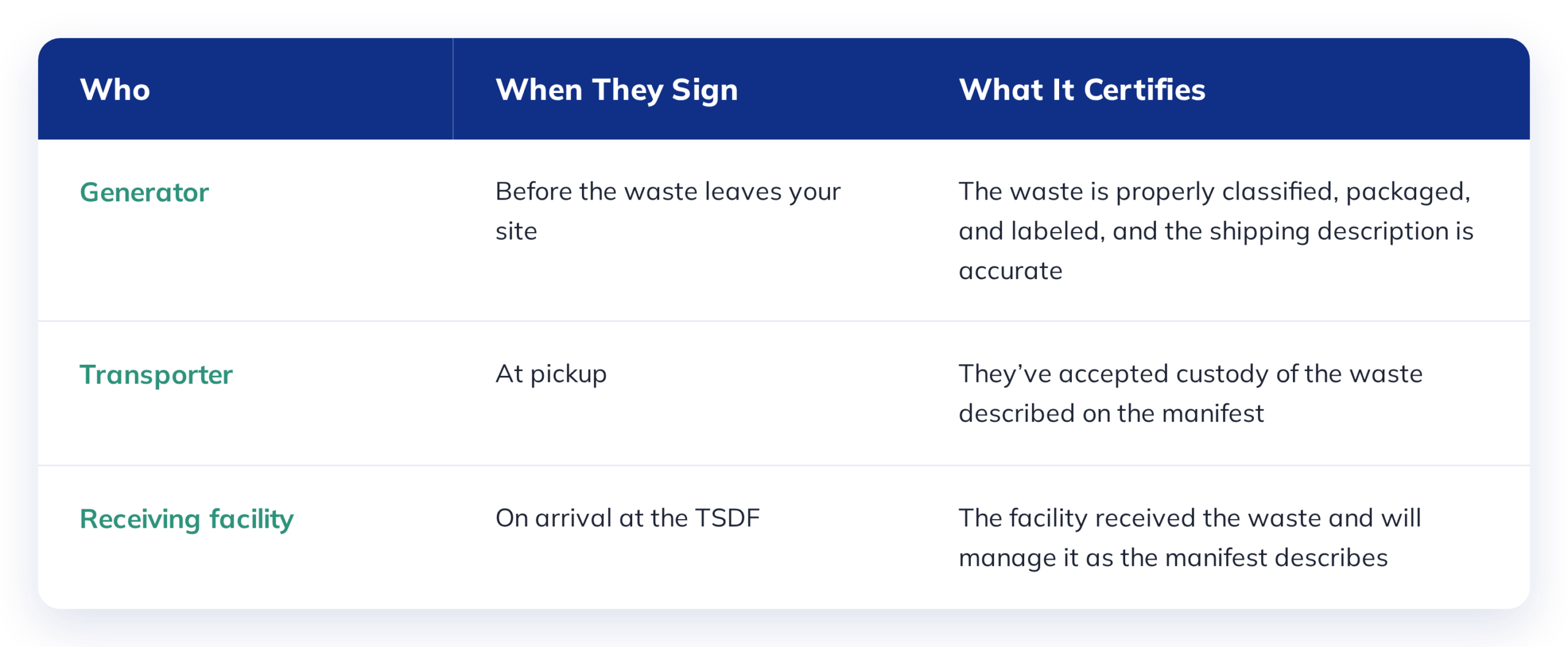
Once the receiving facility signs, it sends a copy back to you. That returned copy is your confirmation the waste arrived and was accepted.
Happily, most of this now happens officially through the EPA’s e-Manifest system. Electronic manifests carry the same legal weight as a hand-signed form, and EPA has proposed sunsetting paper manifests entirely. In short, get comfortable with e-Manifest now.
What Cradle-to-Grave Liability Really Means
Your responsibility for hazardous waste doesn’t transfer when you hand it to a transporter; it stays with you, under RCRA’s cradle-to-grave framework, until the waste reaches its final disposition, no matter who hauled or disposed of it.
That’s why the signed manifest matters so much. It’s the only document that closes the loop and proves, on a specific date, that your waste reached a permitted facility and was handled properly. This is also why the partner you choose for hazardous waste removal matters as much as the disposal method itself. A transporter who’s careless about paperwork puts your compliance record at risk even if the waste itself is handled correctly.
When the Signed Copy Doesn’t Come Back
Sometimes the return copy doesn’t show up on schedule, and EPA has a specific process for that: exception reporting. Here’s how it works:
- If you’re a large quantity generator and haven’t received your signed copy within 45 days of the waste leaving your site, you’re required to contact the transporter or the receiving facility to find out where things stand.
- If you still don’t have confirmation within 60 days, you’re required to file an Exception Report through the e-Manifest system.
- Small quantity generators have a single 60-day deadline to file an Exception Report if confirmation never arrives.
If a signed manifest is late, follow up right away.
For more questions about e-Manifest, see the EPA’s FAQ page on the system.
How Long You Have to Keep the Records
Once your signed uniform hazardous waste manifest comes back, keep it. Federal rules require generators to retain manifests for at least three years from the date the waste was accepted for shipment. Many states extend that window further.
- Keep the signed manifest itself
- Keep any certificates of disposal or destruction the facility provides
- Keep waste profiles and test data tied to that shipment
- Confirm your state’s retention period
A few practical habits help. File manifests by the shipment date, keep digital and physical copies, and store certificates of disposal alongside the manifest they correspond to.
What to Expect From Your Waste Partner
Good documentation support shouldn’t be something you have to chase down. A waste partner worth its salt tracks manifest status proactively, flags a missing signature before you have to ask, and can hand you a complete, organized record the moment you need one.
Miller Environmental Group handles manifesting and waste characterization as part of every job. We classify your waste correctly upfront, and stay on top of manifest returns so you’re never the one chasing paperwork. That kind of support is part of what we bring to every waste transportation and disposal engagement, whether it’s a single hazardous waste removal or an ongoing program across multiple sites.
A Hazardous Waste Manifest Is Proof, Not Paperwork
A hazardous waste manifest is what turns “we had it hauled away” into proof your waste was handled correctly. Know who’s supposed to sign it, know what to do if the signed copy doesn’t come back, and keep your records organized once it does.
If you want a waste partner who treats manifesting as seriously as disposal itself, get in touch with Miller Environmental Group.
