You’re a facilities manager. Winter’s here, and it’s five degrees outside. The generator test just failed and the filter you pulled is coated in something that you know shouldn’t be there. It might look like white wax, or black slime, or even weak tea. Now what?
Most winter fuel failures trace back to three sources: water, sludge, and gelling. These three common occurrences rarely show up alone. You’re seeing it now because diesel fuel contamination builds quietly in storage tanks for months, and the first hard freeze is usually what exposes it. Here’s how to work back from the symptom to the source and get ahead of the next cold snap.
What You’re Seeing and What’s Causing It
Start with the symptom, i.e., what you’re seeing. The table below covers the most common signs of diesel fuel contamination in stored fuel and what each one usually means.
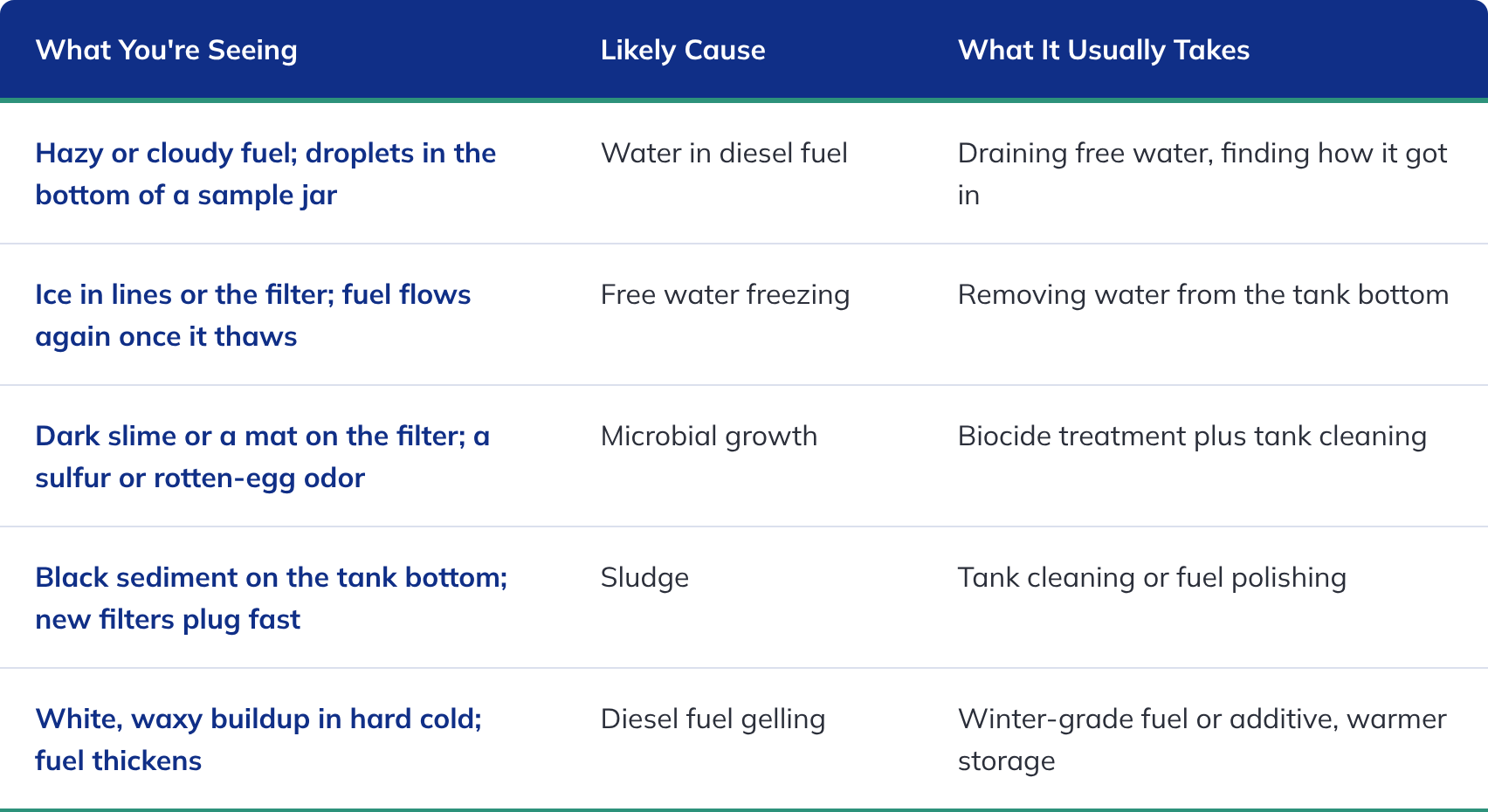
More than one row above often fits the issue. Water feeds microbes, microbes make sludge, and sludge leaves filters with less room to handle wax when temperatures drop. When the cause is sitting in the tank, swapping filters only buys time.
Water in Diesel Fuel: Where It Comes From
Water is the most common contaminant in stored diesel. Most water in diesel tank systems gets in one of a few ways:
- Condensation in partly empty tanks, as air inside warms and cools
- Deliveries that bring water along with the fuel
- Failed vent caps, fill caps, and seals that let rain and snowmelt in
Water is heavier than diesel, so it sinks and collects at the bottom of the tank, right where the pickup line draws fuel. In winter, it freezes in lines and filters and can stop a generator as fast as gelled fuel. It’s no surprise the Transportation Energy Institute’s Diesel Fuel Storage and Handling Guide recommends checking for water before and after every delivery.
Sludge and Microbial Growth
Bacteria and fungi live where fuel meets water. They feed on the fuel, form slimy biofilms, and leave behind a dark sludge that settles on the tank floor. Ultra-low sulfur diesel and biodiesel blends may have made this more common, since they offer microbes fewer natural obstacles than older diesel did.
Sludge is the kind of fuel contamination you won’t spot from the fill port. It becomes apparent downstream:
- Filters that plug again days after a change
- Injector and pump wear
- Corrosion on tank walls and floors
When the EPA inspected underground diesel storage tanks, it found moderate or severe corrosion in 83% of them, and it named microbial activity as a likely factor. Biocides can kill microbes, but they don’t remove the sludge and dead growth already on the tank bottom.
Diesel Fuel Gelling: Why Dirty Fuel Gels Sooner
Diesel naturally contains paraffin wax. As the temperature drops past the fuel’s cloud point, the wax starts to form crystals. Keep it cold long enough and the crystals clump together. Thicken the fuel, and plug filters. This is known as diesel fuel gelling.
The difference between gelling and icing:
- Gelled fuel looks cloudy or waxy and stays thick until it warms well above freezing.
- Ice forms from water in the system and clears once it thaws.
A filter that’s already half-loaded with sludge and water has less capacity left for wax. A tank carrying diesel fuel contamination can stall equipment at a temperature that clean fuel would handle without trouble.
When a gelled or contaminated tank takes down a critical generator during a storm, it moves past being a maintenance task and becomes an emergency response situation.
How to Prevent Diesel From Gelling: A Pre-Winter Checklist
Knowing how to prevent diesel from gelling is half the job; the other half is keeping the tank clean. Before the first freeze:
- Ask your fuel supplier for a winterized blend or a properly dosed anti-gel additive for your region’s climate.
- Keep tanks topped off to cut down on condensation.
- Check for water in diesel tank bottoms after every delivery, and drain it promptly.
- Pull bottom samples monthly and look for haze, water, and sediment.
- Test annually. If the tank is connected to an emergency generator, NFPA 110 calls for a fuel quality test at least once a year.
- Inspect vents, caps, and seals for cracks or missing gaskets.
- Clean the tank if samples show water, slime, or sediment.
Additives can lower the temperature at which fuel gels, but they can’t undo fuel contamination that’s already in the tank.
When the Problem Is Already in the Tank
Once diesel fuel contamination has built up, there are two main paths. Fuel polishing filters and circulates the fuel to strip out water and particulates, and it works well when the fuel itself is still sound. Full tank cleaning removes the water, sludge, and biofilm from the tank floor and walls. It’s recommended when sediment is heavy or microbes have taken hold.
Either way, what comes out of the tank can’t go in a dumpster. Water, sludge, and badly contaminated fuel are a waste stream that has to be characterized, transported, and documented. Miller Environmental Group handles just that through its waste transportation and disposal services. The same team that cleans your tank tracks the material to final disposal.
Get Your Equipment Up and Running Again, ASAP
A failed test on the coldest morning of the year is the wrong time to learn what’s going in your diesel tank. Miller Environmental Group has more than 50 years of experience in industrial cleanup, with 27 locations across the eastern U.S. Here’s how it works:
- Tell us what you’re seeing. A clogged filter, cloudy sample, or failed test is enough to start.
- We assess the tank and recommend polishing, cleaning, or both.
- We clean it and handle the waste, from removal through documented disposal.
Talk to Miller Environmental Group about your fuel tank.
If your equipment is down right now and you need assistance immediately, call us at (800) 394-8606. We answer the phone 24/7.
